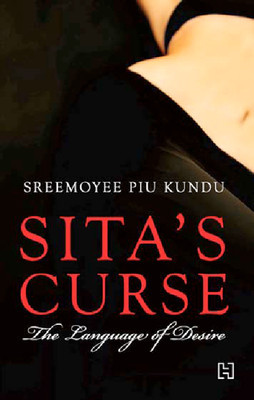
By Sreemoyee Piu Kundu
Genre: EroticaOK
The Book Club Rating : 2 Stars
Somewhere, behind closed doors, in her solitary world; somewhere, under the sheets with an indifferent lover; Somewhere, is a woman who will not be denied. Trapped for fifteen years in the stranglehold of a dead marriage and soulless household domesticity, the beautiful, full-bodied and passionate Meera Patel depends on her memories and her flights of fancy to soothe the aches that wrack her body; to quieten an unquenchable need. Until one cataclysmic day in Mumbai, when she finally breaks free... Bold, brazen and defiant, Sitas Curse looks at the hypocrisy of Indian society and tells the compelling story of a middle-class Indian housewifes urgent need for love, respect, acceptance and sexual fulfillment
Buy at: Amazon.in | Amazon.com
Liberation is both internal and external. Placing liberation into slots somehow fractures its whole purpose, renders its useless. For instance what use is sexual liberation if you are chained to many other dogmas and thinkings surrounding you? Again seeking sexual freedom is seen as the ultimate form of liberation when you unshackle yourself from the guilt and biases that surround the seeking of this pleasure. ‘Sita’s Curse’ begins on this very premise.
Meera the feminist and the feminine: Meera is aware of her sexuality right from the time she steps into adolescence. For the first time we are seeing a woman, a Bharatiya Nari at that from a subservient family aware of her desires and fantasies and longing of the flesh separate and distinct from the longings of her soul someone whose longings are not reduced to feminine wiles. I liked that.
But somewhere along the way, I felt disconnected. For afterall, isn’t liberation a jouney and not a fleeting moment? I wanted to look into Meera’s soul. Wanted to see how she feels after every affair that she has, the sense of incompleteness or the lack of depth . Why does Meera flit from man to man? How does she see herself?
Meera the feminist and the feminine: Meera is aware of her sexuality right from the time she steps into adolescence. For the first time we are seeing a woman, a Bharatiya Nari at that from a subservient family aware of her desires and fantasies and longing of the flesh separate and distinct from the longings of her soul someone whose longings are not reduced to feminine wiles. I liked that.
But somewhere along the way, I felt disconnected. For afterall, isn’t liberation a jouney and not a fleeting moment? I wanted to look into Meera’s soul. Wanted to see how she feels after every affair that she has, the sense of incompleteness or the lack of depth . Why does Meera flit from man to man? How does she see herself?
Publisher: Hachette India (2014)


